Many patients want straighter teeth, but not everyone wants their orthodontic treatment to be visible or take a long time. My patients always ask me: Dr Amanda, how can I accelerate my treatment?
This is especially true for working adults, professionals, public-facing individuals, brides- and grooms-to-be, and patients who want to improve their smile without feeling self-conscious during treatment.
At the same time, patients often want to know whether teeth can be moved faster, safely, and more discreetly. Traditional braces, ceramic self-ligating braces, and clear aligners can all be effective depending on the case, but some patients may be looking for a treatment option that combines speed, precision, and hidden placement.
This is where Brava by Brius lingual braces may be worth considering.
Unlike traditional braces, which are placed on the front surface of the teeth, Brava by Brius is placed behind the teeth, making it much less visible during daily conversations, photos, and professional interactions.
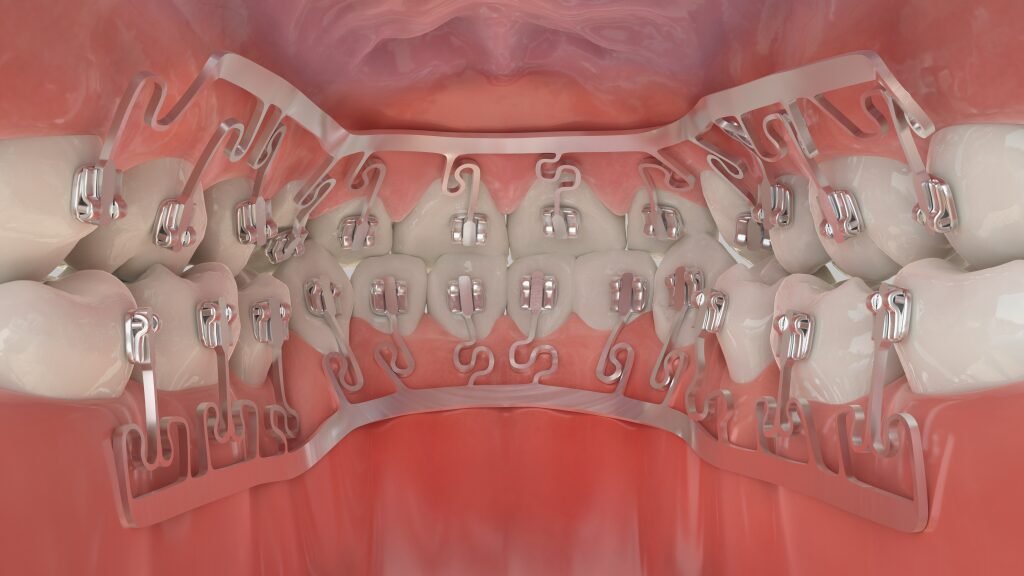
It is also designed differently from conventional braces, as each tooth can be moved more independently using a customised system. This may allow selected cases to move more efficiently compared to some traditional orthodontic approaches.
However, Brava by Brius is also typically more expensive than metal braces, ceramic braces, and many clear aligner options like Invisalign and Angel Aligner. The higher cost is usually due to the customised appliance design, advanced treatment planning, specialised clinical workflow, and the complexity of placing braces behind the teeth.
Before starting treatment, most patients want clear answers to practical questions: How much does Brava by Brius cost? How long will treatment take? How many dental visits are needed? Is it faster than clear aligners or ceramic self-ligating braces? Am I suitable for it? Will I still need retainers after treatment?
In this guide, we explain how Brava by Brius lingual braces work, how they compare with ceramic self-ligating braces and clear aligners, what affects the cost, what your treatment journey may look like, and how to find out whether this discreet orthodontic option is suitable for your teeth.
- How Can I Move Teeth Faster?
- Brava by Brius Lingual Braces vs Ceramic Self-Ligating Braces vs Clear Aligners
- How Much Does Brava by Brius Cost?
- What Is The Typical Treatment Journey for Brava by Brius Lingual Braces?
- How long would my treatment take if I do Brava by Brius lingual braces?
- How many visits to the dentist do I need to make if I take up Brava by Brius lingual braces?
- Is there anything else I should know before taking up Brava by Brius lingual braces treatment?
- Do I still need to wear retainers after Brava by Brius lingual braces?
- Am I Suitable For Brava by Brius lingual braces?
- How Can I Get Started on Brava by Brius Lingual Braces?
- Move Teeth Up to 60% Faster and Safely With Brava by Brius Lingual Braces
How Can I Move Teeth Faster?
Thanks to advancements in orthodontic technology, there are now several ways to help teeth move more efficiently during treatment. However, faster treatment does not mean forcing teeth to move aggressively.
Safe orthodontic movement still depends on your bone biology, gum health, tooth roots, bite condition, and the complexity of the tooth movements required.
In selected cases, your dentist may recommend using an adjunctive device together with your orthodontic treatment. One option is a photobiomodulation device, also known as a PBM device. This uses low-level light therapy to support the biological processes involved in tooth movement.
Another option is an orthodontic vibration accelerator, which may be used alongside braces or clear aligners to support aligner seating, comfort, and treatment consistency.
For some patients, a procedure known as micro-osteoperforation may also be considered. This is a minor surgical technique that creates small perforations in the bone around the teeth to stimulate local bone remodelling. In suitable cases, this may help accelerate certain orthodontic movements. However, it is not required for every patient and should only be recommended after a proper clinical assessment.
Your choice of orthodontic system may also affect treatment efficiency. Options such as clear aligners, self-ligating braces, and Brava by Brius lingual braces may help selected cases progress more efficiently when planned correctly. Brava by Brius, in particular, is designed to move teeth individually from behind the teeth, which may support more controlled and efficient movement in suitable cases.
That said, speed should never be the only goal. The priority is to move teeth safely while protecting your gums, roots, bite, and long-term stability. The fastest treatment is not always the best treatment if it compromises your final result. A dentist-led orthodontic assessment is important to determine which acceleration method, if any, is suitable for your case.
Brava by Brius Lingual Braces vs Ceramic Self-Ligating Braces vs Clear Aligners
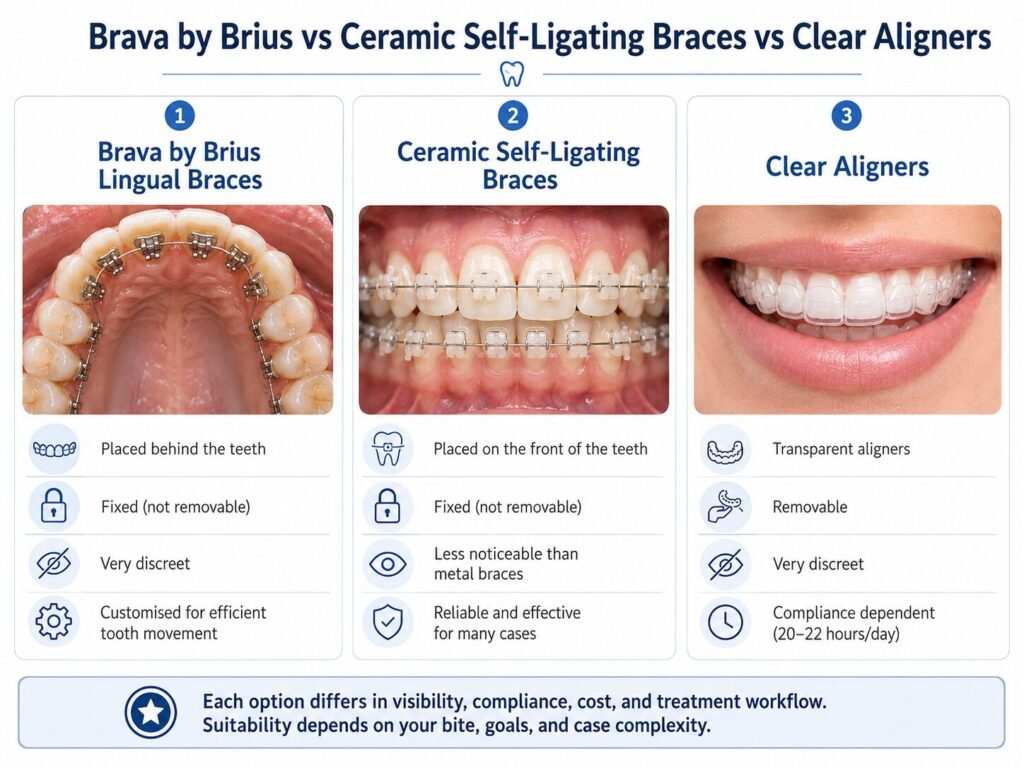
If you want to move teeth faster, the type of orthodontic system you choose can influence your treatment experience, timeline, cost, and how visible your treatment looks day to day. However, there is no single “best” option for everyone. The right choice depends on your bite, tooth movement needed, lifestyle, budget, aesthetic preference, and whether your case requires more complex orthodontic control.
Brava by Brius lingual braces, ceramic self-ligating braces, and clear aligners are all more discreet alternatives to traditional metal braces. Each option has different strengths.
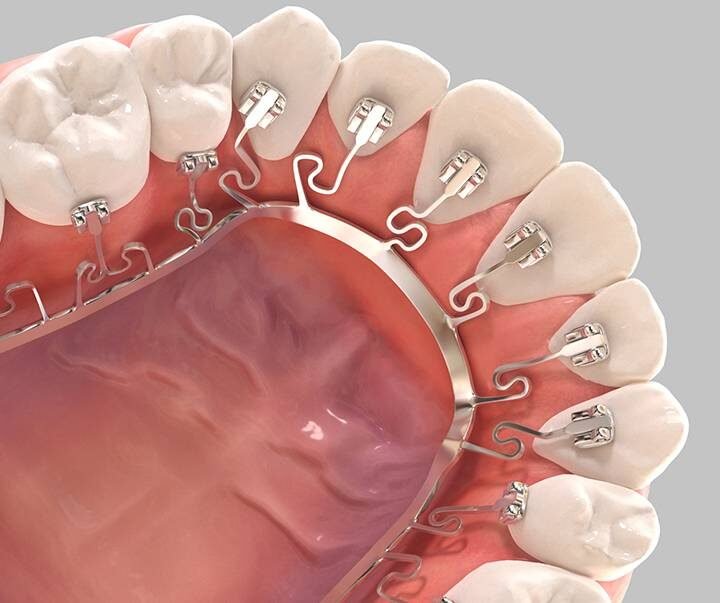
Brava by Brius lingual braces are placed behind the teeth, making them one of the most hidden orthodontic options. They are also designed to move teeth more independently, which may help selected cases progress efficiently. However, they are usually the most costly option because the appliance is highly customised and requires more specialised planning and clinical technique.
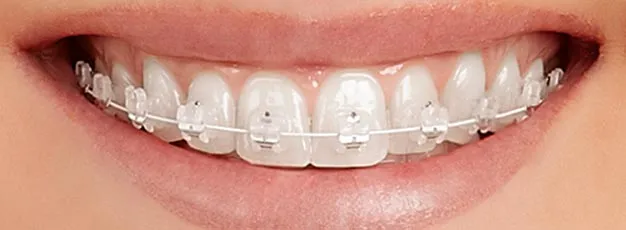
Ceramic self-ligating braces are placed on the front of the teeth, but they use tooth-coloured or clear brackets to make them less noticeable than metal braces. They are often a strong option for patients who want reliable fixed braces with better aesthetics, but do not need the treatment to be completely hidden.
Clear aligners are removable, transparent trays that fit over the teeth. They are popular among adults because they are discreet, removable, and easier to manage socially. However, they depend heavily on patient compliance, because they usually need to be worn for around 20 to 22 hours a day to work predictably.
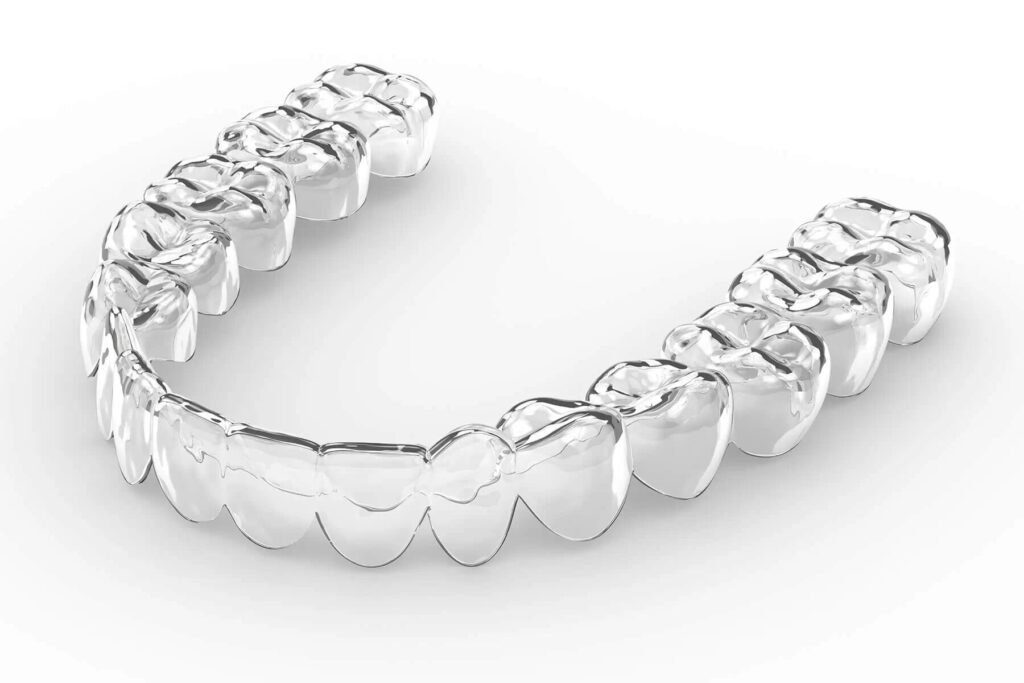
Comparison Table: Brava by Brius Lingual Braces vs Ceramic Self-Ligating Braces vs Clear Aligners
| Factor | Brava by Brius Lingual Braces | Ceramic Self-Ligating Braces | Clear Aligners |
| Estimated price range | Usually the highest-cost option. Often starts from a premium range due to customisation and specialised planning. | Usually more affordable than Brava, but more costly than basic metal braces. | Highly variable. Mild cases may be more affordable, while complex cases with many aligners may cost more. |
| Treatment duration | May be faster in selected cases because each tooth can be moved more independently. | Often efficient for moderate to complex cases because braces are fixed and work continuously. | Can be efficient for mild to moderate cases, but complex cases may take longer and may need refinements. |
| Discomfort level | May cause tongue irritation initially because the braces sit behind the teeth. Speech may also feel different during the adaptation period. | May cause cheek or lip irritation initially because brackets are placed on the front of the teeth. Usually manageable after adaptation. | Usually gentler day to day, but patients may feel pressure when switching to a new aligner set. Attachments may create mild roughness. |
| How discreet it is | Very discreet. The braces are placed behind the teeth and are usually not visible when speaking or smiling. | Moderately discreet. Ceramic brackets blend better with tooth colour but are still visible up close. | Highly discreet. Clear trays are transparent, but attachments and aligner edges may still be visible. |
| Visibility in photos | Usually least visible because the braces are hidden behind the teeth. | May still be seen in close-up photos, especially with wires or stained elastics. | Usually subtle in photos, but attachments and reflections from the trays may show. |
| Removable or fixed | Fixed. Cannot be removed by the patient. | Fixed. Cannot be removed by the patient. | Removable. Can be taken out for eating, drinking, brushing, and flossing. |
| Compliance needed | Lower daily compliance burden because the appliance is fixed. | Lower daily compliance burden because the appliance is fixed. | High compliance required. Poor wear time can delay treatment or affect results. |
| Eating restrictions | Some food restrictions apply because the appliance is fixed behind the teeth. | Some food restrictions apply because brackets and wires can break. | Fewer food restrictions because aligners are removed before eating. |
| Oral hygiene difficulty | More difficult to clean because the braces are behind the teeth. Requires careful brushing and cleaning. | More difficult than aligners, but easier to see and clean than lingual braces. | Easier to brush and floss because aligners can be removed, but teeth must be kept clean before wearing them again. |
| Speech impact | May affect speech initially because the appliance sits near the tongue. | Usually minimal speech impact. | May cause a temporary lisp during the first few days. |
| Best suited for | Patients who want hidden treatment, faster movement where suitable, and are comfortable with a premium option. | Patients who want fixed braces with better aesthetics than metal braces and reliable control. | Patients who want removable, discreet treatment and can commit to wearing aligners consistently. |
| Limitations | Higher cost, tongue discomfort, speech adaptation, and more complex cleaning. | Still visible from the front and may be less discreet than aligners or lingual braces. | Requires strong discipline. Not every complex bite issue can be treated with aligners alone. |
Which Option Should You Choose?
If your main priority is maximum discretion, Brava by Brius lingual braces may be the strongest option because the appliance is placed behind the teeth.
If your priority is predictable fixed orthodontic control with a more aesthetic appearance, ceramic self-ligating braces may be a practical middle ground.
If your priority is removability, convenience, and a discreet day-to-day appearance, clear aligners may be suitable, provided you are disciplined about wearing them.
The key point is that treatment speed does not depend on the appliance alone. It also depends on how complex your case is, whether your gums and bone are healthy, how much tooth movement is needed, and whether refinements or additional appliances are required.
A dentist-led orthodontic assessment is still needed to determine which option can move your teeth safely, efficiently, and predictably.
How Much Does Brava by Brius Cost?
The average cost of Brava by Brius lingual braces in Singapore is typically around $8,500 to $15,000 for the full treatment duration. The final cost depends on the complexity of your case, how much tooth movement is needed, whether bite correction is required, and whether your treatment requires additional orthodontic planning or appliances.
It is also important to check what is included in the quoted fee. Some Brava by Brius treatment fees may not include additional costs such as:
| Possible Additional Cost | Why It May Be Needed |
| Consultation | To assess your teeth, bite, smile goals, and suitability |
| X-rays | To check tooth roots, bone support, impacted teeth, or jaw relationship |
| 3D intraoral scans | To digitally plan your tooth movement and appliance design |
| Other diagnostics | For more complex bite, jaw, or facial profile assessment |
| Extractions | If space is required and non-extraction options are not suitable |
| Surgical extractions | If wisdom teeth or impacted teeth need removal |
| Scaling and polishing | To ensure your teeth and gums are clean before treatment |
| General dentistry work | Fillings, gum treatment, or other dental issues before braces |
| Retainers | To maintain your results after treatment is completed |
At kohe™ Dental, the cost of Brava by Brius lingual braces ranges from $[insert starting price] to $[insert upper price], depending on your case complexity and treatment needs.
Our one-time payment package includes the cost of post-treatment retainers, so you can maintain your results after your Brava treatment is completed. However, the package does not include extractions, surgical extractions, or any other general dentistry work that may be required before or during orthodontic treatment.
This is because every patient starts from a different dental condition. Some patients may only need orthodontic treatment, while others may first require cleaning, fillings, gum treatment, extractions, or other dental procedures before braces can begin safely.
Before confirming your treatment fee, your dentist will usually assess your teeth, bite, oral hygiene, gum health, X-rays, scans, and treatment goals. This allows you to receive a more accurate cost estimate and a clearer understanding of what your Brava by Brius treatment package includes.
Why is the cost of Brava by Brius much higher than metal braces?
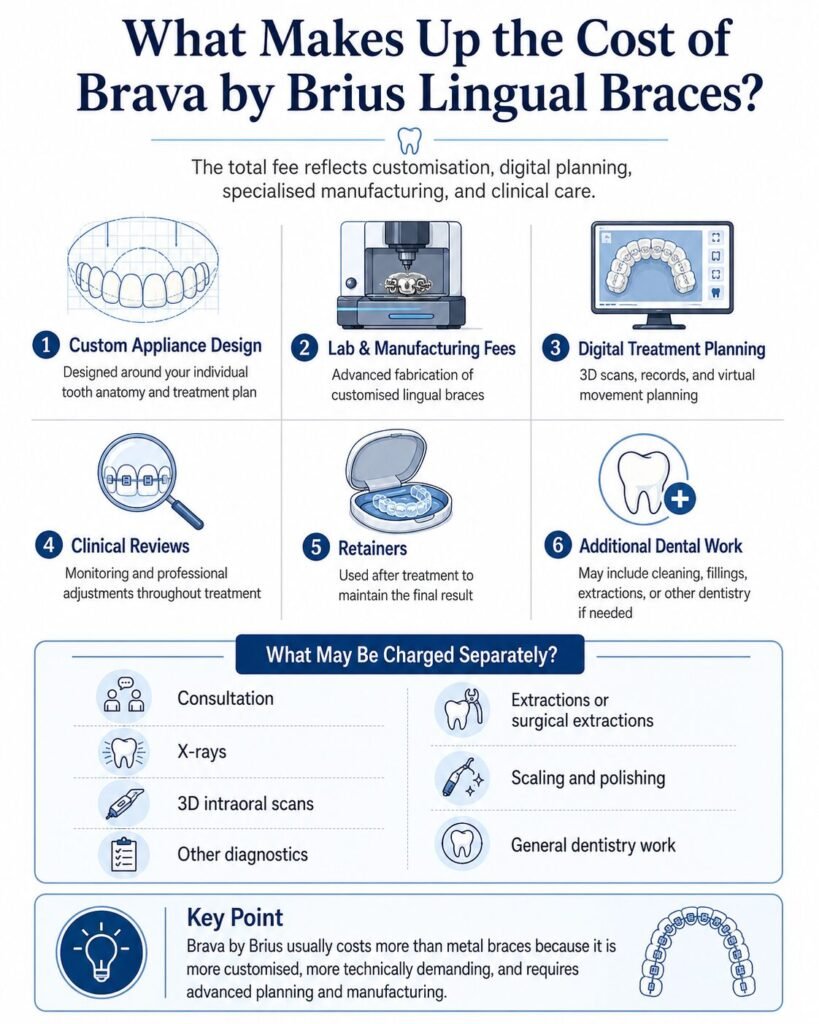
The cost of Brava by Brius lingual braces is usually much higher than standard metal braces because the appliance is significantly more customised, more complex to manufacture, and more technically demanding to plan and place.
Clinicians like myself have to undergo special training to place on Brava by Brius brackets as they are different from metal braces or clear aligners.
With traditional metal braces, the brackets are generally pre-manufactured in standard shapes and sizes. They are not individually customised to the exact anatomy of each patient’s teeth. The dentist bonds the brackets onto the front surface of the teeth and then uses wires, adjustments, and elastic forces to guide tooth movement over time.
Brava by Brius works differently.
Brava by Brius lingual braces are placed behind the teeth, which already makes the treatment more technically complex. The back surface of each tooth is highly irregular and differs from patient to patient. Because of this, the appliance has to be designed and manufactured to match the patient’s unique tooth shape, bite, and treatment plan.
In this sense, Brava by Brius is more similar to clear aligners than traditional metal braces. Like clear aligner treatment, it requires digital planning, customised appliance fabrication, and case-specific manufacturing. The system is not simply a set of standard brackets taken from a box.
The higher cost is usually due to several factors:
| Cost Factor | Why It Increases the Fee |
| Customised appliance design | The appliance is planned according to the patient’s individual tooth anatomy and orthodontic needs. |
| Higher lab and manufacturing fees | Brava by Brius involves more advanced fabrication compared to standard metal brackets. |
| Lingual placement | Brackets are placed behind the teeth, which is more technically difficult and time-consuming. |
| Digital treatment planning | The case may require more detailed planning before the appliance is manufactured. |
| Independent tooth movement | Brava by Brius is designed to move teeth in a more individualised manner, which requires a different appliance structure. |
| Specialised clinical workflow | Placement, monitoring, and adjustments may require more precision compared to conventional braces. |
For many patients, the higher cost is not simply because the braces are “hidden”. The fee reflects the additional customisation, lab work, manufacturing process, treatment planning, and clinical complexity involved.
Metal braces remain a reliable and cost-effective orthodontic option. However, if a patient wants a more discreet system placed behind the teeth, with a customised appliance designed around their individual tooth movement needs, Brava by Brius may be worth considering despite the higher treatment fee.
What Is The Typical Treatment Journey for Brava by Brius Lingual Braces?
When you choose to proceed with Brava by Brius lingual braces, your treatment journey begins with detailed documentation and digital planning. This step is important because Brava by Brius is a customised orthodontic system. The appliance is not taken directly from a standard bracket kit. It has to be planned and manufactured based on your teeth, bite, and treatment goals.
At the first stage, we will take extensive records of your teeth and facial structure. This usually includes X-rays, such as an OPG and Lateral Cephalometric X-ray, as well as 3D intraoral scans and clinical photos of your teeth, bite, smile, and facial profile. In selected cases, we may also take 3D CBCT scans and 3D facial scans, especially if your case involves more complex tooth movement, jaw relationship concerns, asymmetry, impacted teeth, or airway-related assessment.
After your records are completed, the information is sent to Brava by Brius together with detailed clinical documentation notes. These records allow the Brava team to process your case and generate a 3D treatment plan. This is similar in concept to an Angel Aligner iOrtho plan or an Invisalign ClinCheck, where your planned tooth movement can be reviewed digitally before treatment begins.
Once the 3D treatment plan is produced, it will be reviewed and amended by our clinical team. This is an important part of the process because the dentist does not simply accept the first version of the plan automatically. Adjustments may be made to refine the tooth movement, bite outcome, smile aesthetics, treatment sequence, and final result.
After the treatment plan has been reviewed, we will arrange a virtual treatment plan discussion with you. During this discussion, we will explain how your teeth are expected to move, what your treatment progression may look like, how long treatment may take, and whether any additional steps are required.
Once the plan is approved, Brava by Brius will manufacture and ship your customised lingual braces to us. This usually takes around 7 working days after approval.
From there, your bonding appointment can be arranged, and your Brava by Brius treatment can officially begin.
How long would my treatment take if I do Brava by Brius lingual braces?
The average treatment duration for Brava by Brius lingual braces is usually around 5 to 8 months for suitable cases. However, this depends heavily on the complexity of your teeth, bite, jaw relationship, and treatment goals.
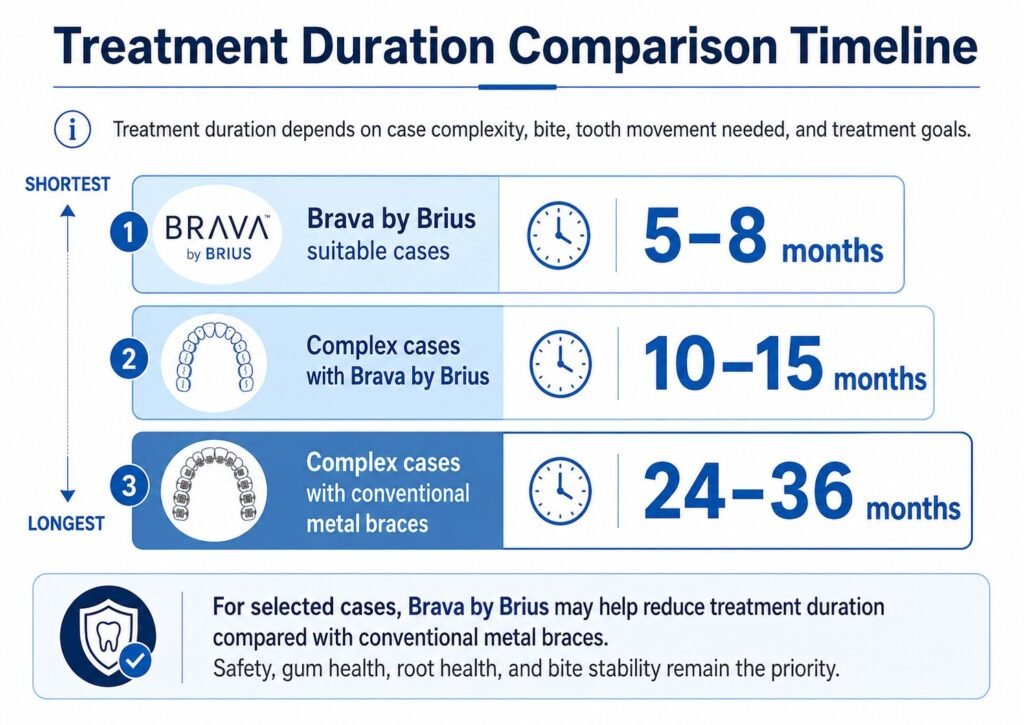
At kohe™ Dental, many of the Brava by Brius cases we see are more complex orthodontic cases. These may include patients with crowding, protrusion, bite issues, rotated teeth, asymmetry, midline concerns, or cases that may otherwise take a much longer time under conventional metal braces.
For some complex cases, treatment that may typically take around 24 to 36 months with metal braces may be completed in approximately 10 to 15 months under the Brava by Brius lingual braces system. This is because Brava by Brius is designed differently from traditional braces. Instead of relying only on a continuous archwire to move teeth together, the system can allow teeth to move more independently and efficiently in selected cases.
That said, treatment duration will always differ from patient to patient. A simpler case may be completed faster, while a more complex case involving bite correction, extractions, expansion, refinements, gum concerns, or additional appliances may require a longer treatment timeline.
It is important not to choose orthodontic treatment based on speed alone. Our first priority is always to ensure that your teeth move safely, predictably, and in a way that protects your gums, roots, bite, and long-term stability. Moving teeth too quickly without proper biological control may increase the risk of complications.
Speed is helpful, but safety comes first. During your consultation, your dentist will assess your teeth, X-rays, scans, bite, and treatment goals before giving you a more accurate estimate of how long your Brava by Brius treatment may take.
How many visits to the dentist do I need to make if I take up Brava by Brius lingual braces?
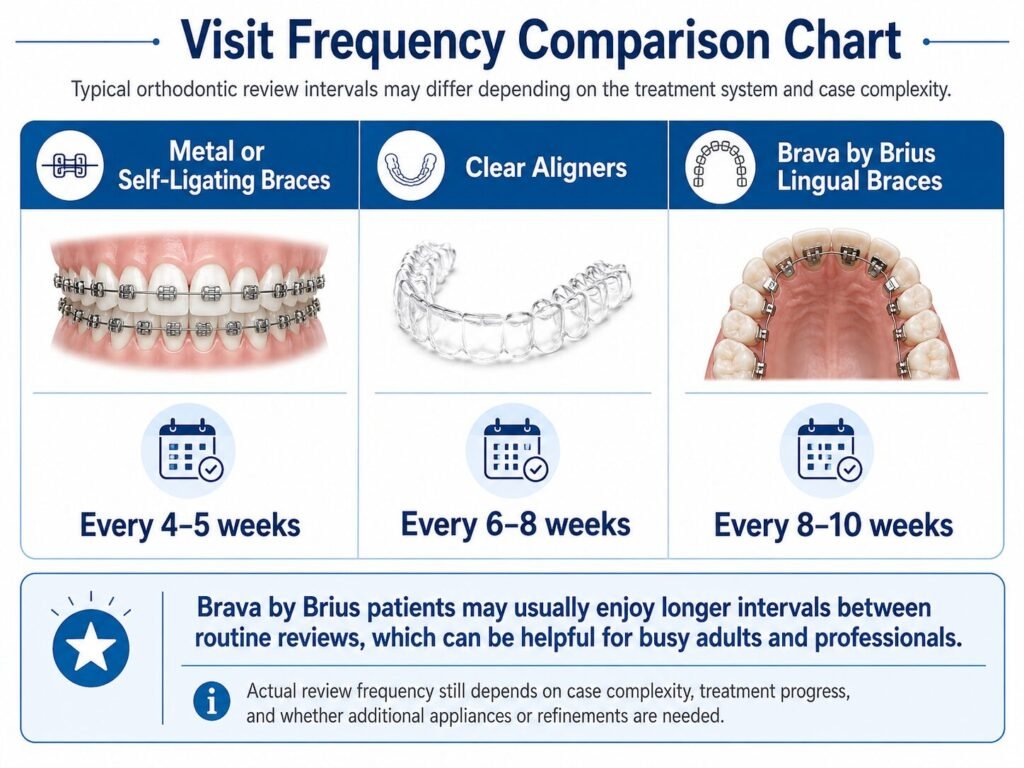
After your Brava by Brius lingual braces have been placed, you will usually need to visit the dentist once every 8 to 10 weeks for review and monitoring. This is generally less frequent compared to many conventional braces systems.
For comparison, patients with metal braces or self-ligating braces may need to return every 4 to 5 weeks for adjustments. Patients undergoing clear aligner treatment may usually return every 6 to 8 weeks, depending on their treatment plan, whether Interproximal Reduction (IPR) is needed mid-treatment, aligner tracking, and whether refinements are needed.
Brava by Brius usually requires fewer routine visits because the appliance is custom-designed and placed behind the teeth. The device has free-forming hands that “memorises” the end point of your desired outcome.
Once bonded securely, it does not usually dislodge as easily as conventional metal braces or self-ligating brackets on the front surface of the teeth. This may reduce the likelihood of last-minute emergency visits caused by broken brackets, loose wires, or dislodged components.
That said, your exact visit frequency will still depend on your case complexity, how your teeth are responding, whether additional appliances are used, and whether your dentist needs to make any refinements to your treatment plan.
For busy adults, professionals, and patients with packed schedules, this can be one of the practical advantages of Brava by Brius. The treatment may offer a more discreet orthodontic option with fewer review appointments, while still allowing your dentist to monitor your progress at important stages of tooth movement.
Is there anything else I should know before taking up Brava by Brius lingual braces treatment?
Before starting Brava by Brius lingual braces, it is important to understand that orthodontic treatment still requires consistent maintenance, even if the appliance is placed behind the teeth and is less visible.
You will still need to attend your scheduled orthodontic review visits so your dentist can monitor your tooth movement, bite changes, gum health, and overall treatment progress. Even though Brava by Brius may require fewer adjustment visits than some conventional braces systems, regular reviews are still necessary to ensure your treatment is progressing safely.
You should also continue with general dental maintenance during treatment. At kohe™ Dental, we generally recommend coming in every 4 to 6 months for professional cleaning, such as scaling and polishing or guided biofilm therapy, depending on your oral hygiene condition. This is important because plaque can still build up around the teeth and gumline during orthodontic treatment. Please do not skip this!
Daily oral hygiene is also essential. You will need to brush thoroughly, floss carefully, and use a mouthwash where suitable. Some patients choose to switch to an electric toothbrush and water flosser to make cleaning easier and more effective during treatment.
Like any orthodontic treatment, Brava by Brius may still cause slight aches, tightness, or discomfort during the initial stage of treatment. This is usually part of the adjustment period as your teeth begin to move.
Because Brava by Brius brackets are placed behind the teeth, they usually do not rub against the inner cheeks in the same way as front-facing braces. However, some patients may experience tongue irritation, slight abrasions, a temporary lisp, or mild discomfort during the first 1 to 2 weeks of wearing them.
Most patients adapt with time. The key is to maintain good oral hygiene, attend your reviews, and follow your dentist’s instructions closely so your treatment remains comfortable, safe, and on track.
Do I still need to wear retainers after Brava by Brius lingual braces?
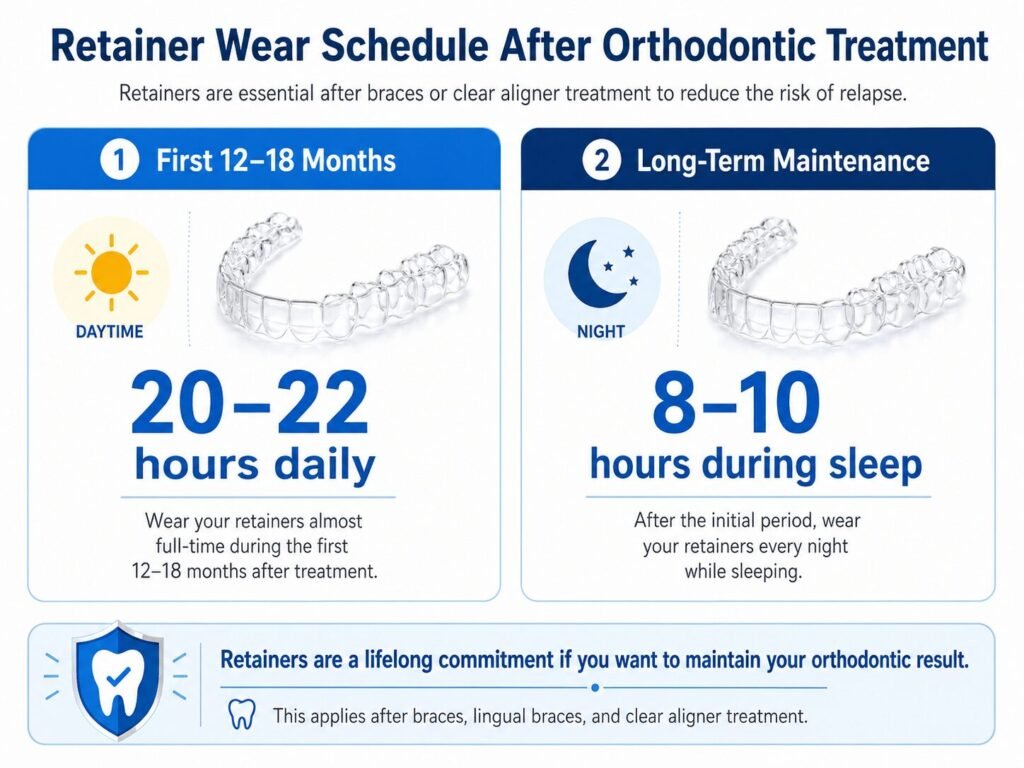
Yes. You will still need to wear retainers after completing Brava by Brius lingual braces treatment.
This applies to all orthodontic treatments, regardless of whether you use metal braces, ceramic self-ligating braces, clear aligners, or lingual braces. Once your teeth have been moved into a new position, they need time to stabilise. Without retainers, there is a high risk that your teeth may gradually shift back towards their original position. This is known as orthodontic relapse.
Retainers are therefore not optional. They are an essential part of maintaining your final result after treatment.
At kohe™ Dental, we generally recommend wearing your retainers for 20 to 22 hours a day for the first 12 to 18 months after completing orthodontic treatment. This helps your teeth, gums, ligaments, and supporting bone adapt to the new tooth positions.
After this initial stabilisation period, you may then move on to wearing your retainers for 8 to 10 hours during sleep. This usually means wearing them overnight.
It is important to understand that retainers are a long-term commitment. In most cases, you will need to wear retainers for life if you want to maintain your orthodontic result. This does not mean wearing them full-time forever, but it does mean continuing with night-time wear as instructed.
Brava by Brius can help move teeth efficiently and discreetly, but the final result still needs to be protected. The braces move your teeth into position. The retainers keep them there.
Am I Suitable For Brava by Brius lingual braces?
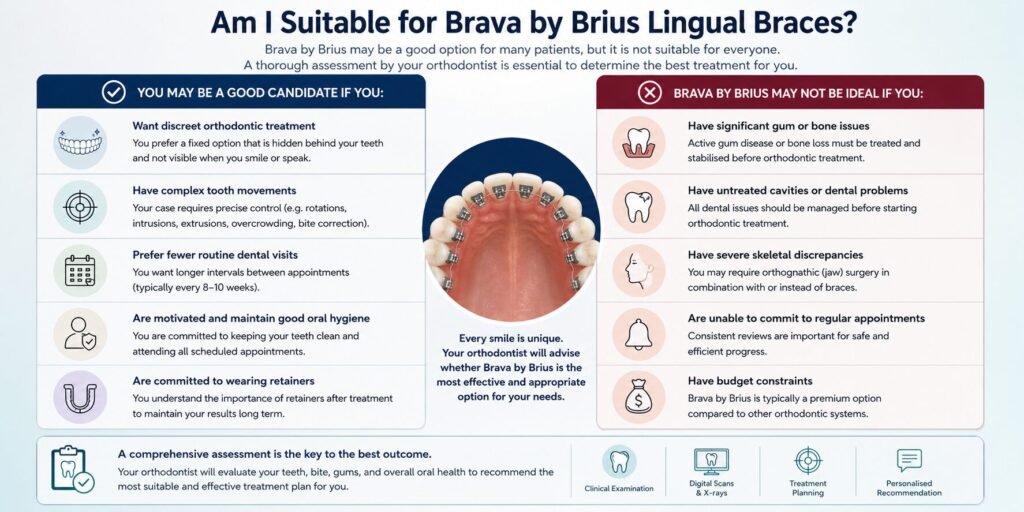
You may be suitable for Brava by Brius lingual braces if you want a discreet orthodontic treatment option that is fixed, hidden behind the teeth, and designed for efficient tooth movement. However, suitability still depends on your tooth shape, bite condition, oral health, and treatment goals.
One important requirement is that you must have enough tooth surface on the lingual side of your teeth. This is the inner surface of the tooth facing the tongue. Because Brava by Brius brackets are placed behind the teeth, your dentist needs to assess whether there is enough space and suitable tooth structure for the brackets to be bonded securely.
Brava by Brius may be considered for patients with simple to severe teeth misalignment, depending on the case. This may include crowding, spacing, rotated teeth, protrusion, bite concerns, or more complex orthodontic movement. However, a full assessment with photos, scans, X-rays, and bite analysis is still needed before confirming whether it is the right treatment option for you.
You may also prefer Brava by Brius if you do not want to worry about daily compliance. Unlike clear aligners, which need to be worn for around 20 to 22 hours a day, Brava by Brius is fixed behind your teeth. This means the appliance is working continuously, and you do not need to remember to put it back on after meals or drinks.
It may also be suitable if you want to reduce the number of dental visits. Brava by Brius patients may usually attend review appointments every 8 to 10 weeks, compared with more frequent visits for some conventional braces systems.
For selected cases, Brava by Brius may also help reduce treatment duration significantly. Some patients may experience a shorter treatment timeline compared with conventional braces, depending on the complexity of movement required. At kohe™ Dental, some complex cases that may traditionally take much longer with metal braces may complete faster under the Brava by Brius system. However, safety remains the priority, and treatment should never be rushed at the expense of gum health, root health, or bite stability.
Brava by Brius may be especially suitable if you want a truly discreet orthodontic option. Because the brackets are placed behind the teeth, they are usually not visible when you smile, speak, or take photos. This makes it a strong option for working adults, public-facing professionals, brides- and grooms-to-be, and patients who want orthodontic treatment without obvious front-facing braces.
You may be suitable for Brava by Brius if you:
| You May Be Suitable If You… | Why It Matters |
| Have enough inner tooth surface | The brackets need sufficient lingual tooth surface for secure bonding |
| Have simple to severe misalignment | Brava may be used for a range of orthodontic concerns, subject to assessment |
| Want a fixed treatment option | You do not need to manage daily aligner wear compliance |
| Want fewer review visits | Appointments may be spaced further apart than conventional braces |
| Want a shorter treatment timeline where suitable | Some cases may progress more efficiently compared with traditional systems |
| Want a highly discreet option | The appliance is placed behind the teeth and is usually hidden from view |
The best way to confirm suitability is through a dentist-led orthodontic assessment. Your dentist will need to check your teeth, bite, gum health, X-rays, 3D scan, facial profile, and treatment goals before advising whether Brava by Brius is appropriate for your case.
How Can I Get Started on Brava by Brius Lingual Braces?
If you are ready to invest in Brava by Brius lingual braces, the first step is to look for an orthodontic-focused clinic with experience in planning and managing Brava by Brius cases. This is important because Brava is not a standard braces system. It requires detailed records, digital planning, customised appliance fabrication, and careful clinical management.
At kohe™ Dental, our clinicians have experience working with a wide range of lingual braces cases, including patients who want a discreet treatment option, shorter treatment duration where clinically suitable, and a fixed orthodontic system that does not depend on aligner wear compliance.
Your Brava by Brius journey usually starts with a consultation and orthodontic assessment. This may include clinical photos, X-rays, 3D intraoral scans, bite assessment, and discussion of your treatment goals. Once your records are taken, your case can be digitally planned before the customised lingual braces are manufactured.
If you already have another clinic in mind, it may help to ask the following questions before deciding:
| Question to Ask | Why It Matters |
| Do you have experience with Brava by Brius lingual braces? | Brava requires a different workflow from standard front-facing braces. |
| How many lingual braces cases have you managed? | Experience matters because the brackets are placed behind the teeth and require precise planning. |
| Can you show me how my teeth are expected to move digitally? | A 3D treatment plan helps you understand the proposed tooth movement before treatment starts. |
| What is included in the treatment package? | Check whether retainers, scans, X-rays, reviews, or refinements are included. |
| Are extractions, cleaning, fillings, or surgical work charged separately? | These are usually not a part of the orthodontic package. |
| How long is my case expected to take? | Treatment duration depends on your bite, tooth movement, and case complexity. |
| How often do I need to come back for reviews? | Brava review visits may usually be spaced further apart than conventional braces. |
| What happens if a bracket dislodges or I feel discomfort? | You should understand the clinic’s support process before starting. |
| Will I need retainers after treatment? | All orthodontic treatment requires retention to reduce relapse risk. |
| Am I truly suitable for Brava, or is another option better? | A good clinic should recommend the option that suits your case, not just the most premium option. |
Brava by Brius may be a strong option if you want a hidden, fixed, and highly discreet orthodontic treatment. However, it should still be chosen based on clinical suitability, not only speed or aesthetics.
The best way to get started is to book a proper assessment, review your treatment options, and understand the cost, timeline, risks, and maintenance requirements before committing.
Move Teeth Up to 60% Faster and Safely With Brava by Brius Lingual Braces
Brava by Brius lingual braces may be suitable for patients who want a faster, discreet, and fixed orthodontic treatment option without visible front-facing braces. Because the appliance is placed behind the teeth, it is designed for patients who want their treatment to remain hidden during daily conversations, work meetings, photos, and important life events.
For selected cases, Brava by Brius may help reduce treatment duration significantly compared with conventional metal braces. At kohe™ Dental, some complex cases that may traditionally take around 24 to 36 months with metal braces may be completed in approximately 10 to 15 months with Brava by Brius, depending on the patient’s bite, tooth movement required, gum health, and overall treatment plan.
However, speed should never be the only reason to choose orthodontic treatment. The safest and most predictable result comes from proper diagnosis, detailed records, 3D treatment planning, regular reviews, and good oral hygiene throughout the treatment journey. Brava by Brius may move teeth efficiently, but your teeth, gums, roots, and bite still need to be protected at every stage.
Before deciding, it is important to understand the full cost, treatment timeline, maintenance requirements, and whether you are clinically suitable. You may also need X-rays, 3D scans, photos, cleaning, fillings, extractions, or other dental work before treatment begins.
If you want a treatment option that is discreet, fixed, efficient, and planned around your individual tooth movement, Brava by Brius lingual braces may be worth considering. The best way to get started is to arrange a dentist-led orthodontic assessment so your clinician can confirm whether this system is appropriate for your teeth, bite, lifestyle, and treatment goals.